
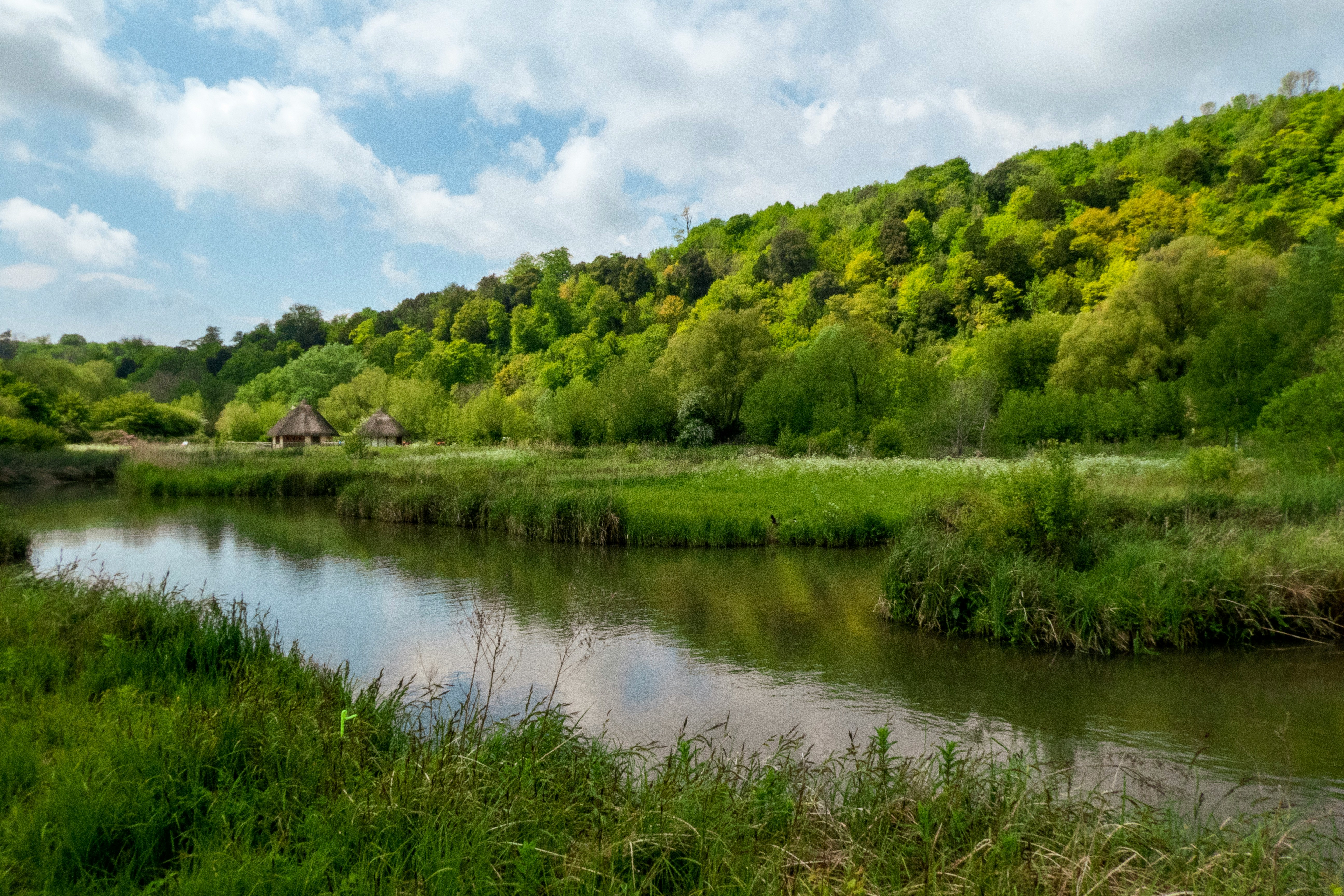
A green landscape amidst parched surroundings can be more than a striking contrast. At the Holnicote Estate in Somerset, England, the difference is, according to the conservation charity National Trust, a visible sign of what happens when water is given more space.
Positive News describes in its news roundup from August 28, 2026, how aerial photographs show the restored wetland appearing lush and green compared to the surrounding landscape. The National Trust, which manages the area, attributes the difference to efforts to reconnect watercourses, restore wetlands, and reintroduce beavers. The goal is to retain water in the landscape.
What is intriguing is not merely the color in an aerial photograph. It is the underlying principle: a landscape can be engineered to channel water away rapidly—or to allow it to stay.
A landscape can be engineered to channel water away rapidly—or to allow it to stay.
A Departure from Rapid Drainage
National Trust project manager Ben Eardley describes the effort as reversing a longstanding practice. For generations, wetlands have been drained, rivers straightened, and water channeled away from the land as quickly as possible. At Holnicote, work has moved in the opposite direction.
According to Positive News, the UK has lost around 90 percent of its wetlands over the past century. That figure puts the local project into perspective: restoration is not just about protecting the nature that remains, but also about restoring the landscape's capacity to retain water.
Holnicote combines several interventions in one location. However, the source does not provide a basis for determining how much of the described effect is attributable to the streams, the wetlands, or the beavers respectively.
What Can a Green Landscape Tell Us?
The images provide a vivid illustration, but they do not in themselves constitute a comprehensive measurement of the project's impact. The coverage in Positive News does not include figures for local water levels, retained water volumes, or changes in flood risk.
It is therefore important to distinguish between the visible contrast and the broader potential highlighted by the National Trust. The organization points out that nature-based solutions can reduce flood risk, improve water quality, boost biodiversity, and strengthen resilience against drought. The coverage does not document that all these benefits have been measured at Holnicote.
This does not make the example any less interesting. Rather, it sharpens the question of documentation: How much water is retained, for how long, and what does it mean for nature and the surrounding land?
Nature as Part of Resilience
Holnicote points to an approach where nature restoration and climate adaptation are integrated. In this view, a wetland is not merely a habitat, but also a potential component of the landscape's resilience against both too much and too little water.
This single account cannot prove this to be a blueprint that works everywhere. But the project challenges a deep-seated assumption: that sound water management inevitably means draining it away. In some places, the most crucial work may be giving it room to stay.