
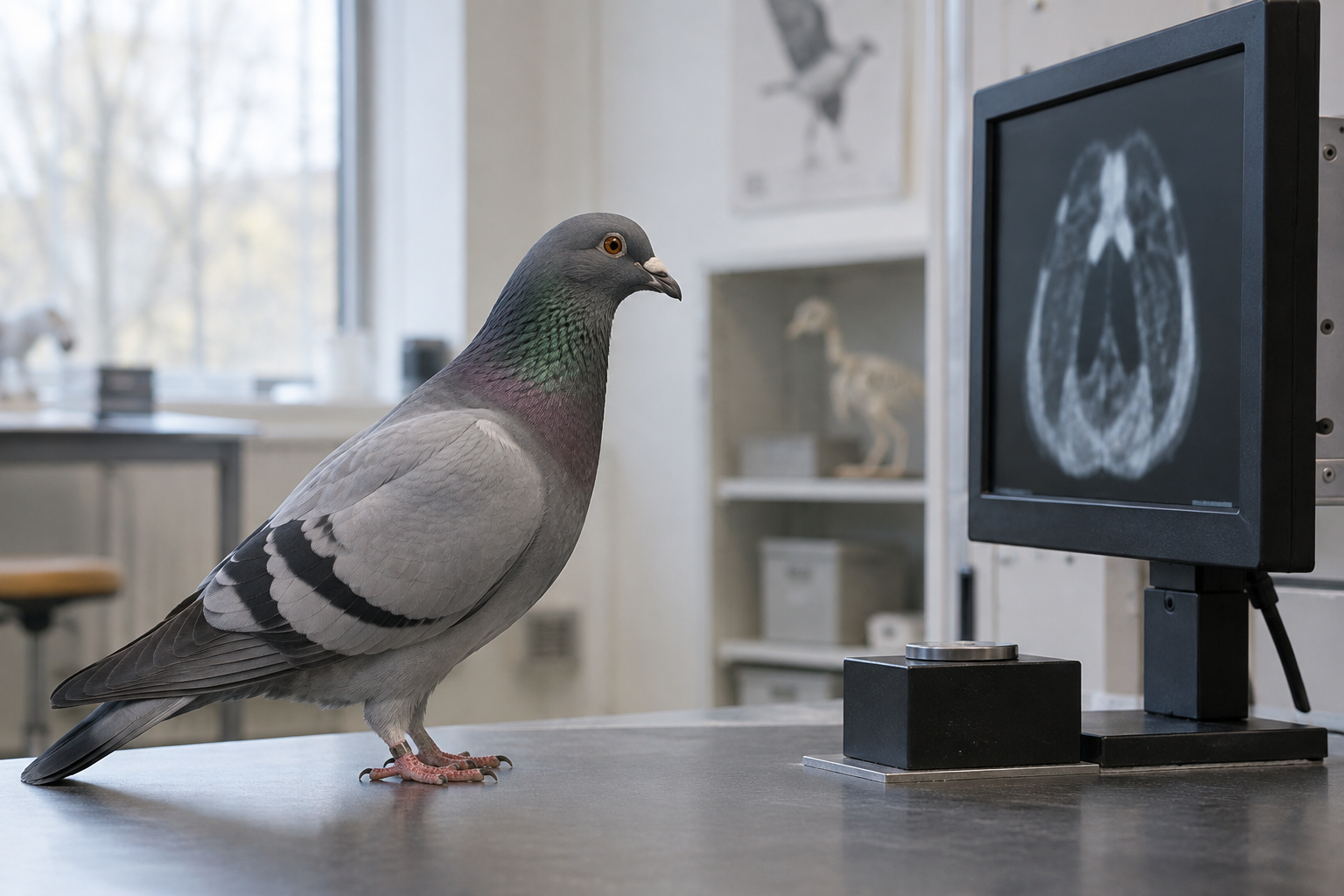
A pigeon will not read your next hospital scan. But the bird may help scientists understand why people sometimes miss signs of disease.
As Popular Science reports, researchers trained six pigeons to watch short videos of CT scans. These scans show the inside of the body. The birds learned to tell scans with small lung growths from those without them.
The growths are called nodules. Some can be a sign of cancer. Spotting a nodule, though, is not the same as knowing whether it is cancer.
Spotting a nodule is not the same as knowing whether it is cancer.
Learning to spot a difference
The research was led by Gregory DiGirolamo at the College of the Holy Cross in Massachusetts.
Half the pigeons received food when they correctly spotted scans with nodules. The other half received food when they correctly identified scans without them.
With training, the birds learned the task. They could also tell the difference in scans they had not seen before. This suggests they had learned more than how to remember a set of pictures.
The birds also began to pick up signs of two problems they had not been trained to find. One was emphysema, which damages the air sacs in the lungs. The other was a type of hazy spot called a ground-glass nodule.
According to DiGirolamo, these look very different from the nodules used in training. The findings suggest the birds may have noticed a visual feature shared by all three. What that feature is remains an open question.
Seeing is not always noticing
Why study birds rather than just train doctors more? The aim is to explore how vision works before we become aware of what we see.
In a separate study published in 2025, DiGirolamo and his team tracked the eyes of doctors who read medical scans. Sometimes, a doctor looked at a lung nodule but still judged the scan to be normal.
Their eyes stayed on the spot, and their pupils grew wider. The researchers took these changes as signs that the brain had picked up something unusual, even though the doctor did not report it.
DiGirolamo uses pigeons to explore visual skills that may work in similar ways to parts of human vision outside our awareness. The birds are a research tool, not a stand-in for a doctor's full judgment.
A possible path to better tools
The next goal is to use these insights to help doctors. DiGirolamo hopes to train artificial intelligence, or AI, with data on where doctors look and how their pupils change.
Such a tool might one day draw attention to a scan that deserves another look. It would support doctors, not replace them.
That is a research goal, not a proven benefit for patients. The pigeon study does not show that birds can diagnose cancer or that a new AI tool is ready for use.
Its value lies in a simpler idea: our eyes may take in more than we can explain. Studying a pigeon's skill could help us understand that gap—and, in time, find ways to reduce it.